Business Ebook vs Amazon Ebook: Two Completely Different Goals
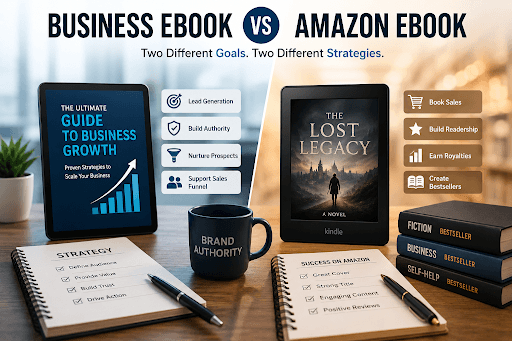
What Is a Business Ebook?
- Generate leads by offering the ebook as a free download in exchange for an email address
- Build authority by demonstrating deep expertise in a niche
- Nurture prospects through a sales funnel
- Educate clients before, during, or after a service engagement
- Establish brand voice across a market segment
What Is an Amazon Ebook?
- Generate passive income through royalties
- Build a readership and fan base
- Establish author credibility on a platform with a massive reach
- Create a series that keeps readers coming back
- Pursue traditional publishing deals off the back of sales success
Side-by-Side Comparison
| Feature | Business Ebook | Amazon Ebook |
|---|---|---|
| Primary Goal | Lead generation/brand authority | Book sales/royalty income |
| Price | Free (gated content) | Paid ($0.99 – $9.99+) |
| Length | 1,500 – 10,000 words | 10,000 – 80,000+ words |
| Distribution | Company website, landing page, email | Amazon KDP, Kindle Unlimited |
| Tone | Professional, educational, branded | Varies by genre (narrative, instructional, etc.) |
| SEO/Marketing Role | Central to inbound strategy | Secondary to product quality |
| Success Metric | Leads, conversions, downloads | Sales rank, reviews, royalties |
| Reader Expectation | Quick, actionable insight | Immersive, complete reading experience |
| Call to Action | Book a call, visit a page, buy a product | Leave a review, buy the next book |
| Hiring Need | Ebook writing agency with marketing knowledge | Ebook writer with genre and storytelling expertise |
Goal #1: The Business Ebook Is a Sales Tool in Disguise
- A compelling title — keyword-rich, benefit-driven, and audience-specific
- A clear problem statement — your reader needs to feel seen in the first 200 words
- Actionable frameworks — step-by-step insights, not vague theory
- Brand voice consistency — the ebook must sound like the company
- Strategic CTAs — soft sells that feel helpful, not pushy
- Visual formatting — charts, callout boxes, bold stats that make skimming productive
Goal #2: The Amazon Ebook Is a Product That Must Compete
- Fit squarely within a genre with proven demand
- Have a professionally designed cover (readers absolutely judge books by their covers)
- Maintain consistent pacing, tension, or instructional value from start to finish
- Open with a killer hook — the first page has to earn the second
- Deliver on its title promise completely and satisfyingly
- Accumulate reviews to build social proof and algorithmic ranking
- Potentially be part of a series to maximize lifetime reader value
The Writing Differences Are More Than Stylistic
"73% of B2B buyers research three or more vendors before making a purchase decision. That means your prospects are already evaluating you — the question is whether your content is doing the selling or your competitor's content is."
Notice: data-driven, authority-projecting, problem-aware, and subtly positioning the brand as the solution.
"The first time I lost a client to a competitor, I didn't see it coming. We had a great relationship, solid deliverables, and what I thought was trust. It turned out I had confused familiarity with loyalty, and that lesson cost me $40,000."
Notice: narrative hook, personal vulnerability, reader empathy, storytelling-led rather than data-led.
When Should You Use Each Type?
- Grow your email list with a lead magnet
- Position your brand as a thought leader in your niche
- Support a product launch or service offering
- Create educational content for prospects at various funnel stages
- Drive traffic through gated content on your website
- Build a passive income stream from royalties
- Establish yourself as a published author in your field
- Reach a massive audience without your own distribution infrastructure
- Test a book concept before investing in print publishing
- Build a Kindle Unlimited readership over multiple titles
How to Hire the Right Writer for Each
- Experience with B2B content marketing or lead generation copywriting
- A portfolio that includes white papers, case studies, or landing pages
- Understanding of brand voice, CTAs, and funnel strategy
- Familiarity with design coordination (they don't need to design it, but they should know how it'll look)
- A discovery process that asks about your audience, goals, and offer
- Genre-specific writing experience (fiction, self-help, business narrative, etc.)
- Knowledge of KDP publishing, metadata, and keyword optimization
- Ability to write to the length and pacing standards of your genre
- A portfolio of published Kindle titles with verified sales or reviews
- Understanding of chapter hooks and reader retention techniques
Final Thoughts: Same Word, Different World
FAQs
1. What is the main difference between a business ebook and an Amazon ebook?
A business ebook is a free marketing asset designed to generate leads and build brand authority. It lives inside a sales funnel. An Amazon ebook is a paid consumer product sold on the Kindle marketplace to generate royalty income. Same format, completely different purpose, audience, and success metrics.
2. How long should each type of ebook be?
Business ebooks typically range from 1,500 to 10,000 words, long enough to deliver real value, short enough to be consumed in one sitting. Amazon ebooks vary widely by genre: non-fiction guides average 15,000 to 30,000 words, while fiction titles can run 50,000 to 100,000+ words. When you hire an ebook writer talent, always clarify the target length upfront.
3. Can I use the same ebook writing services for both types?
Not always, and this is a critical distinction. Many ghostwriting services specialize in one format or the other. Business ebook writers come from a content marketing or copywriting background, while Amazon ebook writers are trained in genre conventions, narrative structure, and KDP publishing. Always ask for format-specific samples before committing.
4. Do I need to hire a separate designer when I create a business ebook?
In most cases, yes. A skilled ebook writing service handles the words, but a polished business ebook also needs professional layout design, branded colors, callout boxes, visual hierarchy, and a compelling cover. Many agencies offer writing and design as a bundled package, which is worth considering for consistency and turnaround time.
5. Which type of ebook is better for building personal authority?
Both work, but in different arenas. A business ebook builds authority within your existing audience and niche. It's perfect for coaches, consultants, and B2B brands. An Amazon ebook builds public credibility on a global marketplace and can reach readers who've never heard of you. If you want the widest possible authority footprint, a two-track strategy — one business ebook for your funnel and one Amazon title for discoverability — is a powerful combination.
Author Bio:
Alex Philips is a professional content specialist focused on book publishing and author services. He writes and reviews technical and informative content to help aspiring and seasoned authors navigate the professional publishing process. His work focuses on quality, trust, and hassle-free creative writing.
GET FREE CONSULTATION
Recent Posts
Why Thousands of Authors Trust Berg Publisher for Professional Publishing Services?
Our Publishing Services Explained | Expert Book Publishing Services
Client Satisfaction Comes First at Berg Publisher Book Publishing Agency
Is hiring a ghostwriter from a ghostwriting agency worth it?
Why professional authors choose ghostwriting services?
Can I Hire a Ghostwriter Online to Write My Life Story?
What are eBook writing services, and how do they help businesses generate leads?
What Berg Publisher Does as a Leading Professional Book Publishing Agency?
A Guide to Understand Rights and Credits Retention in Ghostwriting Services.
Why Book Editing is More Important Than You Think?
How to Choose the Right eBook Writing Service for Your Book or Business?
Common Mistakes Authors Make Without an eBook Writing Service
How Much Do eBook Writing Services Cost?
Professional eBook Writing, Ghostwriting and Editing Services for Authors
Best Book Publishing Agencies for Aspiring Authors 2026
Manuscript getting rejected again and again?: 2026 best book editing service
Explore the top book marketing services: Self-book publishing authors 2026
10 major benefits of hiring fiction ghostwriting services for your novel
How to design a professional book cover that sells in 2026
How to Hire a Fiction Ghostwriter for Your Novel
How to Choose a Book Publishing Agency for International Distribution?
How Book Publishing Agencies Choose Which Manuscripts to Publish?
The Day-to-Day Workflow of a Professional Book Publishing Agency?
How Editors at a Book Publishing Agency Shape Your Manuscript into a Bestseller?
AI vs human ghostwriters: Which is best for writing books in 2026?| ghostwriting services
What Most Authors Don't Know About Book Publishing Agency Submission Processes?
AI Ghostwriting in 2026: How Human Ghostwriters Still Add Value
Ghostwriting Services | Best AI Tools for Writing Books in 2026
Behind the Scenes: How Agencies Decide Marketing Budgets for Books?
How a Book Publishing Agency Evaluates Manuscript Potential (2026 Guide)
Do AI tools beat human writers?| Book publishing services explained
Book Publishing Service Explain, Will AI Replace Authors?
10 Reasons to Hire a Professional eBook Writer in 2026
30+ Questions to Ask an Author About Their Book (With Answer Guides)
How to Write a Book Without Typing
How Book Publishing Services Help Veterans Share Their War Stories?
How Agencies Handle Multiple Authors Efficiently?
How Book Publishing Agency Experts Predict Reader Trends?
Why Book Editing Services and Editors Matter in the AI-Driven Publishing Era?
Pricing Secrets: How a Book Publishing Agency Decides Author Royalties?
How does a Book Marketing Agency Handle Sci-Fi, Fantasy, and Romance Books Differently?
How to Negotiate the Best Deal with a Book Publishing Agency (2026 Guide)
I Published My First Book at 60: Guide to Book Publishing Services for First-Time Authors
The Real Cost of Publishing a Book via Book Publishing Services in 2026?
30+ Questions Every Author Should Ask Before Using Book Publishing Services
Hire an EBook Writer to Build Brand Authority
Why Book Launches Get Delayed (and How to Avoid It)
Is Your Book Ready to Be Published? Check Now
Manuscript to Published Book: A Step-by-Step Guide
Famous CEO Books That Were Written by Ghostwriters
Common Publishing Mistakes Every Author Should Avoid
Legal Requirements for Publishing a Book in the USA
What Successful Self-Published Authors Do Differently
Will Your Book Ever Pay You Back? Here's the Truth
Choosing the Right Genre and Category for Your Book
Hidden Contract Clauses Authors Miss in Book Deals
Best Fiction Writing Services | Berg Publishers
Who Owns a Ghostwritten Book? | Berg Publishers
Book Publishing Services That Don't Hide the Price
Ghostwriter vs. Co-Author: Which One Is Right? | Berg
How CEOs Become Published Authors | Berg Publishers
Amazon Publishing vs. Berg Publishers: Which Wins?
How to Vet a Ghostwriter: A 10-Point Checklist
Vanity Press Warning: 12 Red Flags Before You Sign
eBook Writing Service: How to Choose the Right One
Why Ebooks Fail: 8 Honest Reasons You Can't Ignore
5 Reasons to Hire an Editor Before Self-Publishing a Book
How to Tell If Your Book Is Competing Against an AI Knockoff on Amazon
How to Promote an Ebook After Publishing: Beyond Amazon and Your Website
How to Sell Short Stories on Amazon Kindle: Tips and Tricks for New Authors
8 Podcast Recommendations for Writers and Self-Publishers (2026 Edition)
An Interview with USA Today Bestselling Author Kelly
How Do I Publish a Book for Free on Amazon Kindle Direct Publishing (KDP)? The Complete Step-by-Step Process
AI and Book Publishing in 2026: 4 Changes Every Author Should Know
Which Fonts and Font Sizes Are Best for Your Book's Interior Formatting?
Business Ebook vs Amazon Ebook: Two Completely Different Goals
Cost vs Value: Is a Professional Agency Worth It for Your Book?
15 Creative Book Marketing Ideas for Self-Published Authors (2026 Guide)
2026 Publishing Trends: What Authors, Editors & Publishers Must Know
Internal vs External Conflict: How They Are Used in a Story
Book Royalty Calculator: KDP vs IngramSpark vs Draft2Digital (Exact Math)
Best Publishing Platforms 2026 to 2027: The Ultimate Comparison Guide
AI Book Cover Design: Legal Risks Every US Author Must Know in 2026
How to Hire and Work with a New York Ghostwriting Company
How Much Do Ghostwriters Cost in New York? A Complete NYC Pricing Guide for 2026
The Ultimate Guide on How to Write a Book in 2026
Tips for Authors Writing in Less Popular or Emerging Genres
Top 10 Best Selling Authors of All Time | Book Publishing

We create books that connect with audiences. From the initial outline to publication and marketing, we support our clients throughout the entire process.
SERVICES
- Fiction Ghostwriting
- Non-Fiction Ghostwriting
- Book Editing
- Book Printing
- Book Marketing
- Audiobook Publishing
- Hybrid Publishing
- IngramSpark Publishing
- ISBN and Copyright Registration
- Book Cover Design
- eBook Writing
- Self-Publishing for Tech Founders
- Amazon Publishing
- Self-Publishing vs Traditional Publishing
- Book Publishing Timeline & Process
- Book Publishing Cost USA
- Author Success Stories & Case Studies
- Biography Writing
- Novel Writing