Legal Requirements for Publishing a Book in the USA
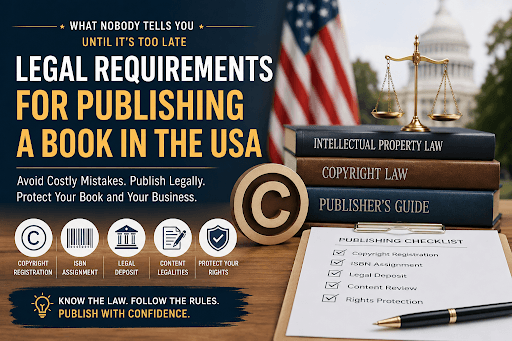
The Legal Landscape of U.S. Book Publishing
Step 1: Copyright Automatic, But Not Enough
- You can claim ownership but can't sue for statutory damages
- You can't recover attorney's fees in infringement cases
- You have no public record of ownership that holds up in court
- You can sue for up to $150,000 per willful infringement
- Attorney's fees are recoverable
- Your ownership is publicly documented
- File at copyright.gov costs $45–$65
- File before or within 3 months of publication for full protection
- Processing takes 3–11 months, but protection is effective from filing date
Step 2: ISBN Not Required by Law, But Practically Mandatory
- The official U.S. ISBN agency is Bowker (myidentifiers.com)
- Single ISBN: $125 | Block of 10: $295
- Each format (paperback, hardcover, eBook, audiobook) needs a separate ISBN
- Free ISBNs from platforms like KDP list the platform as publisher of record not you
Step 3: Legal Deposit The Requirement Nobody Talks About
- Fine of up to $250 per work
- Plus the retail cost of the copies
- Willful non-compliance: up to $2,500
Legal Requirements Based on Your Content
If Your Book Contains Real People
- Public figures must prove "actual malice" a higher bar
- Private individuals have a much lower burden of proof
- Satire is protected but must be clearly recognizable as satire
- Opinion is protected; false statements of fact are not
If Your Book Uses Third-Party Content
Step 4: Business and Tax Considerations
- LLC vs. Sole Proprietor — An LLC separates personal assets from publishing liability, relevant if your book generates significant income or carries defamation risk
- EIN — Required if publishing under a business name; obtain free from the IRS
- Royalty income — All publishing royalties are taxable, reported on Schedule C or E
- W-9 and 1099 forms — Platforms request a W-9 before paying royalties; issue a 1099-MISC if annual payments exceed $600
- International sales — VAT and GST obligations may apply depending on country and platform
Step 5: Platform-Specific Legal Requirements
| Platform | Key Requirement |
|---|---|
| Amazon KDP | Disclose AI-generated content; no misleading metadata |
| KDP Select | Exclusivity terms prohibit wide distribution |
| Ingram Spark | Proof of rights ownership; specific file standards |
| Library platforms | Separate licensing required for OverDrive, hoopla |
Why Legal Compliance Is a Publishing Partner Decision
What Berg Publishers Handles So You Don't Have To
- Copyright registration guidance and filing support
- ISBN assignment under your name or imprint never the platform's
- Legal deposit coordination with the Library of Congress
- Third-party content review during the editorial process
- Platform-specific compliance checks before distribution
- Business structure consultation for authors building an imprint
Your Pre-Publication Legal Checklist
- Copyright registered with the U.S. Copyright Office
- ISBN purchased under your name or imprint
- Legal deposit copies prepared for the Library of Congress
- Third-party content reviewed for permissions
- Real-person portrayals reviewed for defamation risk
- Business structure decided (sole proprietor vs. LLC)
- EIN obtained if publishing under a business name
- Platform terms of service reviewed for each channel
- AI-generated content disclosed where required
FAQs
1. Do I need a business license to publish a book in the USA?
There's no federal publishing license requirement. However, publishing under a business name may require a DBA registration in your state and possibly a local business license. If you form an LLC, you'll register with your state's Secretary of State office. Requirements vary consult a local business attorney for specifics.
2. Can I publish a book based on real events without getting sued?
Yes with careful attention to how real people are portrayed. True facts about public figures are generally protected. False statements of fact that damage anyone's reputation can expose you to defamation claims. Have any manuscript involving identifiable people reviewed by a publishing attorney before publication, particularly if anyone is portrayed negatively.
3. Do I need to trademark my book title?
Book titles are generally not protectable under U.S. copyright law a single title is too short to qualify. However, a series title or author brand can be trademarked if it functions as a source identifier. If you're building a series brand, trademark registration through the USPTO is worth discussing with an IP attorney.
4. What happens if I publish without an ISBN?
Your book can be sold directly from your own website, for example without an ISBN. But without one, your book cannot be listed in the retail systems used by Amazon, Barnes & Noble, Ingram, and library networks. For any author wanting wide distribution, an ISBN is practically mandatory.
5. How long does U.S. copyright protection last?
For works created after January 1, 1978, copyright lasts for the life of the author plus 70 years. For works made for hire or published anonymously, the term is 95 years from publication or 120 years from creation whichever is shorter. After expiration, the work enters the public domain.
Author Bio:
Isabella Watson is a professional content specialist focused on book publishing and author services. She writes and reviews technical and informative content to help aspiring and seasoned authors navigate the professional publishing process. Her work focuses on quality, trust, and hassle-free creative writing.
GET FREE CONSULTATION
Recent Posts
Why Thousands of Authors Trust Berg Publisher for Professional Publishing Services?
Our Publishing Services Explained | Expert Book Publishing Services
Client Satisfaction Comes First at Berg Publisher Book Publishing Agency
Is hiring a ghostwriter from a ghostwriting agency worth it?
Why professional authors choose ghostwriting services?
Can I Hire a Ghostwriter Online to Write My Life Story?
What are eBook writing services, and how do they help businesses generate leads?
What Berg Publisher Does as a Leading Professional Book Publishing Agency?
A Guide to Understand Rights and Credits Retention in Ghostwriting Services.
Why Book Editing is More Important Than You Think?
How to Choose the Right eBook Writing Service for Your Book or Business?
Common Mistakes Authors Make Without an eBook Writing Service
How Much Do eBook Writing Services Cost?
Professional eBook Writing, Ghostwriting and Editing Services for Authors
Best Book Publishing Agencies for Aspiring Authors 2026
Manuscript getting rejected again and again?: 2026 best book editing service
Explore the top book marketing services: Self-book publishing authors 2026
10 major benefits of hiring fiction ghostwriting services for your novel
How to design a professional book cover that sells in 2026
How to Hire a Fiction Ghostwriter for Your Novel
How to Choose a Book Publishing Agency for International Distribution?
How Book Publishing Agencies Choose Which Manuscripts to Publish?
The Day-to-Day Workflow of a Professional Book Publishing Agency?
How Editors at a Book Publishing Agency Shape Your Manuscript into a Bestseller?
AI vs human ghostwriters: Which is best for writing books in 2026?| ghostwriting services
What Most Authors Don't Know About Book Publishing Agency Submission Processes?
AI Ghostwriting in 2026: How Human Ghostwriters Still Add Value
Ghostwriting Services | Best AI Tools for Writing Books in 2026
Behind the Scenes: How Agencies Decide Marketing Budgets for Books?
How a Book Publishing Agency Evaluates Manuscript Potential (2026 Guide)
Do AI tools beat human writers?| Book publishing services explained
Book Publishing Service Explain, Will AI Replace Authors?
10 Reasons to Hire a Professional eBook Writer in 2026
30+ Questions to Ask an Author About Their Book (With Answer Guides)
How to Write a Book Without Typing
How Book Publishing Services Help Veterans Share Their War Stories?
How Agencies Handle Multiple Authors Efficiently?
How Book Publishing Agency Experts Predict Reader Trends?
Why Book Editing Services and Editors Matter in the AI-Driven Publishing Era?
Pricing Secrets: How a Book Publishing Agency Decides Author Royalties?
How does a Book Marketing Agency Handle Sci-Fi, Fantasy, and Romance Books Differently?
How to Negotiate the Best Deal with a Book Publishing Agency (2026 Guide)
I Published My First Book at 60: Guide to Book Publishing Services for First-Time Authors
The Real Cost of Publishing a Book via Book Publishing Services in 2026?
30+ Questions Every Author Should Ask Before Using Book Publishing Services
Hire an EBook Writer to Build Brand Authority
How Much Do Ghostwriters Charge? (Per Word, Per Project, Per Book)
Poetry Publishing: Why It Needs Different Treatment
Why Book Launches Get Delayed (and How to Avoid It)
Is Your Book Ready to Be Published? Check Now
Manuscript to Published Book: A Step-by-Step Guide
Famous CEO Books That Were Written by Ghostwriters
Common Publishing Mistakes Every Author Should Avoid
Legal Requirements for Publishing a Book in the USA
What Successful Self-Published Authors Do Differently
Will Your Book Ever Pay You Back? Here's the Truth
Choosing the Right Genre and Category for Your Book
Hidden Contract Clauses Authors Miss in Book Deals
Best Fiction Writing Services | Berg Publishers
Who Owns a Ghostwritten Book? | Berg Publishers
Book Publishing Services That Don't Hide the Price
Ghostwriter vs. Co-Author: Which One Is Right? | Berg
How CEOs Become Published Authors | Berg Publishers
Amazon Publishing vs. Berg Publishers: Which Wins?
How to Vet a Ghostwriter: A 10-Point Checklist
Vanity Press Warning: 12 Red Flags Before You Sign
eBook Writing Service: How to Choose the Right One
Why Ebooks Fail: 8 Honest Reasons You Can't Ignore
5 Reasons to Hire an Editor Before Self-Publishing a Book
How to Tell If Your Book Is Competing Against an AI Knockoff on Amazon
How to Promote an Ebook After Publishing: Beyond Amazon and Your Website
How to Sell Short Stories on Amazon Kindle: Tips and Tricks for New Authors
8 Podcast Recommendations for Writers and Self-Publishers (2026 Edition)
An Interview with USA Today Bestselling Author Kelly
How Do I Publish a Book for Free on Amazon Kindle Direct Publishing (KDP)? The Complete Step-by-Step Process
AI and Book Publishing in 2026: 4 Changes Every Author Should Know
Which Fonts and Font Sizes Are Best for Your Book's Interior Formatting?
Business Ebook vs Amazon Ebook: Two Completely Different Goals
Cost vs Value: Is a Professional Agency Worth It for Your Book?
15 Creative Book Marketing Ideas for Self-Published Authors (2026 Guide)
2026 Publishing Trends: What Authors, Editors & Publishers Must Know
Internal vs External Conflict: How They Are Used in a Story
Book Royalty Calculator: KDP vs IngramSpark vs Draft2Digital (Exact Math)
Best Publishing Platforms 2026 to 2027: The Ultimate Comparison Guide
AI Book Cover Design: Legal Risks Every US Author Must Know in 2026
How to Hire and Work with a New York Ghostwriting Company
How Much Do Ghostwriters Cost in New York? A Complete NYC Pricing Guide for 2026
The Ultimate Guide on How to Write a Book in 2026
Tips for Authors Writing in Less Popular or Emerging Genres
Top 10 Best Selling Authors of All Time | Book Publishing

We create books that connect with audiences. From the initial outline to publication and marketing, we support our clients throughout the entire process.
SERVICES
- Fiction Ghostwriting
- Non-Fiction Ghostwriting
- Book Editing
- Book Cover Design
- Book Printing
- Book Marketing
- Book Launch Services
- Amazon Ads for Authors
- Amazon Listing Optimization
- Author Website Design
- Audiobook Publishing
- Business Book Publishing
- Children's Book Publishing
- Memoir Publishing
- Hybrid Publishing
- IngramSpark Publishing
- ISBN and Copyright Registration
- eBook Writing
- Self-Publishing for Tech Founders
- Amazon Publishing
- Self-Publishing vs Traditional Publishing
- Book Publishing Timeline & Process
- Book Publishing Cost USA
- Author Success Stories & Case Studies
- Biography Writing
- Novel Writing