How to Tell If Your Book Is Competing Against an AI Knockoff on Amazon
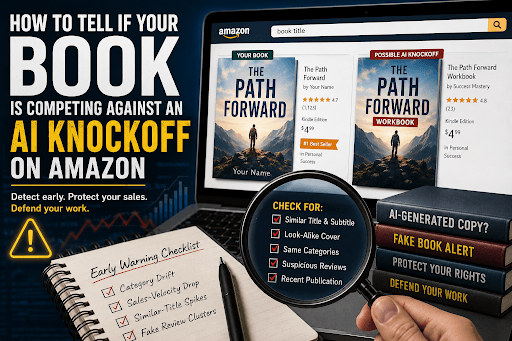
Why AI Knockoffs Are Hard to Spot (Until It's Too Late)
- Near-identical titles and subtitles with slight keyword reshuffling
- Covers that echo your color palette, typography, and layout
- The same Amazon browse categories and backend keywords
- "Workbook," "Summary," "Companion Guide," or "Study Guide" framing that borrows your book's brand equity
The Early Warning Diagnostic Framework
Signal 1: Category Drift
- Record your BSR and your rank in each browse category twice a week (a simple spreadsheet works).
- Watch for your category rank falling faster than your overall BSR. That divergence often means a new title is absorbing category-specific search traffic.
- Browse your top two categories' "New Releases" list weekly. Knockoffs almost always launch into your exact categories because they copied your metadata.
Signal 2: Sales-Velocity Drop Without a Cause
- Compare week-over-week ordered units in KDP Reports. A knockoff dip is typically sudden (within 3–5 days), sustained, and search-driven. Your Amazon Ads impressions may hold steady while organic sales fall.
- If you run Amazon Advertising, watch your click-through rate on branded keyword campaigns (your name, your title). A falling CTR on your own title's keyword is a strong sign shoppers are seeing and clicking something that looks like your book.
Signal 3: Similar-Title Spikes in Search
- Once a week, search your exact title, your subtitle's main keyword phrase, and "your title + workbook/summary/guide" in an incognito browser.
- Note every new result published in the last 30 days. Check the "Publication date" filter to isolate them.
- Look up the "author" name. AI-generated knockoffs usually come from author profiles with no bio, no photo, and 10–40 books published in a few months across unrelated niches — a classic content-farm fingerprint.
Signal 4: Fake-Review Clusters
- Suspicious pattern: 5–15 five-star reviews landing within 48–72 hours of publication, with generic praise ("Great book! Very helpful!") and no Verified Purchase badges.
- Reviewer profiles that review dozens of unrelated products in the same week.
- Occasionally, confused readers leave one-star reviews on your book saying "this isn't what I ordered" — a sign that buyers are mixing up the two listings. Read your own recent reviews carefully.
Quick-Reference Diagnostic Table
| Warning Signal | Where to Check | Healthy Baseline | Red Flag Threshold |
|---|---|---|---|
| Category drift | Product page → category rank | Moves with BSR | Category rank drops 2× faster than BSR |
| Sales velocity | KDP Reports → Orders | Gradual, explainable shifts | Sudden 3–5 day drop; organic falls while ad impressions hold |
| Similar titles | Incognito Amazon search | 0–1 loosely related new titles | New title mimicking yours within 30 days |
| Review clusters | Competitor's review page | Slow, verified, varied reviews | 10+ unverified 5-stars in 72 hours |
| Branded keyword CTR | Amazon Ads console | Stable CTR on your title terms | CTR declines while impressions hold |
What to Do If You Confirm a Knockoff
- Document everything first. Screenshot the listing, cover, publication date, ASIN, and review patterns before reporting — listings sometimes vanish and reappear under new ASINs.
- Report through the right channel. Use Amazon's "Report an issue with this product" link, and if your copyright or trademark is infringed, file through Amazon's Report Infringement form (Brand Registry accelerates this if you have a trademark).
- Invoke KDP's AI-disclosure rules where relevant. Amazon now requires publishers to disclose AI-generated content; undisclosed AI knockoffs violate KDP content guidelines, which is a separate reporting angle from copyright.
- Strengthen your own listing. Add A+ Content, claim your Author Central page, and bid on your own branded keywords so shoppers see your legitimate edition first.
- Escalate collectively if needed. The Authors Guild has an infringement-support process for members, and pattern-based complaints from multiple authors move faster than solo reports.
The Bottom Line
FAQs
1. How quickly do AI knockoffs appear after a book launch?
Documented cases show derivative titles appearing within 2–3 days of a successful release, particularly for books that hit "Hot New Releases" lists. High-visibility launches are targeted fastest.
2. Can Amazon remove an AI-generated knockoff of my book?
Yes, if it infringes your copyright or trademark, violates KDP's AI-content disclosure policy, or manipulates reviews. Removal is faster with documentation, a registered trademark, and Brand Registry enrollment.
3. Do AI knockoffs actually hurt sales, or just look bad?
They hurt in two ways: splitting organic search traffic (impression leakage) and confusing buyers into purchasing the wrong edition, which can also generate misdirected negative reviews on your listing.
4. Is using AI in publishing always bad?
No. AI-assisted editing, research, and marketing workflows are legitimate and increasingly standard. The problem is undisclosed, derivative content designed to impersonate or free-ride on another author's work.
5. How can I protect my book from knockoffs before launch?
Register your copyright early, consider trademarking your series or brand name, enroll in Amazon Brand Registry, claim your Author Central profile, and set up weekly title-search alerts from day one. Prevention and fast detection together are far cheaper than post-damage recovery.
Author Bio:
Isabella Watson is a professional content specialist focused on book publishing and author services. She writes and reviews technical and informative content to help aspiring and seasoned authors navigate the professional publishing process. Her work focuses on quality, trust, and hassle-free creative writing.
GET FREE CONSULTATION
Recent Posts
Why Thousands of Authors Trust Berg Publisher for Professional Publishing Services?
Our Publishing Services Explained | Expert Book Publishing Services
Client Satisfaction Comes First at Berg Publisher Book Publishing Agency
Is hiring a ghostwriter from a ghostwriting agency worth it?
Why professional authors choose ghostwriting services?
Can I Hire a Ghostwriter Online to Write My Life Story?
What are eBook writing services, and how do they help businesses generate leads?
What Berg Publisher Does as a Leading Professional Book Publishing Agency?
A Guide to Understand Rights and Credits Retention in Ghostwriting Services.
Why Book Editing is More Important Than You Think?
How to Choose the Right eBook Writing Service for Your Book or Business?
Common Mistakes Authors Make Without an eBook Writing Service
How Much Do eBook Writing Services Cost?
Professional eBook Writing, Ghostwriting and Editing Services for Authors
Best Book Publishing Agencies for Aspiring Authors 2026
Manuscript getting rejected again and again?: 2026 best book editing service
Explore the top book marketing services: Self-book publishing authors 2026
10 major benefits of hiring fiction ghostwriting services for your novel
How to design a professional book cover that sells in 2026
How to Hire a Fiction Ghostwriter for Your Novel
How to Choose a Book Publishing Agency for International Distribution?
How Book Publishing Agencies Choose Which Manuscripts to Publish?
The Day-to-Day Workflow of a Professional Book Publishing Agency?
How Editors at a Book Publishing Agency Shape Your Manuscript into a Bestseller?
AI vs human ghostwriters: Which is best for writing books in 2026?| ghostwriting services
What Most Authors Don't Know About Book Publishing Agency Submission Processes?
AI Ghostwriting in 2026: How Human Ghostwriters Still Add Value
Ghostwriting Services | Best AI Tools for Writing Books in 2026
Behind the Scenes: How Agencies Decide Marketing Budgets for Books?
How a Book Publishing Agency Evaluates Manuscript Potential (2026 Guide)
Do AI tools beat human writers?| Book publishing services explained
Book Publishing Service Explain, Will AI Replace Authors?
10 Reasons to Hire a Professional eBook Writer in 2026
30+ Questions to Ask an Author About Their Book (With Answer Guides)
How to Write a Book Without Typing
How Book Publishing Services Help Veterans Share Their War Stories?
How Agencies Handle Multiple Authors Efficiently?
How Book Publishing Agency Experts Predict Reader Trends?
Why Book Editing Services and Editors Matter in the AI-Driven Publishing Era?
Pricing Secrets: How a Book Publishing Agency Decides Author Royalties?
How does a Book Marketing Agency Handle Sci-Fi, Fantasy, and Romance Books Differently?
How to Negotiate the Best Deal with a Book Publishing Agency (2026 Guide)
I Published My First Book at 60: Guide to Book Publishing Services for First-Time Authors
The Real Cost of Publishing a Book via Book Publishing Services in 2026?
30+ Questions Every Author Should Ask Before Using Book Publishing Services
Hire an EBook Writer to Build Brand Authority
Poetry Publishing: Why It Needs Different Treatment
Why Book Launches Get Delayed (and How to Avoid It)
Is Your Book Ready to Be Published? Check Now
Manuscript to Published Book: A Step-by-Step Guide
Famous CEO Books That Were Written by Ghostwriters
Common Publishing Mistakes Every Author Should Avoid
Legal Requirements for Publishing a Book in the USA
What Successful Self-Published Authors Do Differently
Will Your Book Ever Pay You Back? Here's the Truth
Choosing the Right Genre and Category for Your Book
Hidden Contract Clauses Authors Miss in Book Deals
Best Fiction Writing Services | Berg Publishers
Who Owns a Ghostwritten Book? | Berg Publishers
Book Publishing Services That Don't Hide the Price
Ghostwriter vs. Co-Author: Which One Is Right? | Berg
How CEOs Become Published Authors | Berg Publishers
Amazon Publishing vs. Berg Publishers: Which Wins?
How to Vet a Ghostwriter: A 10-Point Checklist
Vanity Press Warning: 12 Red Flags Before You Sign
eBook Writing Service: How to Choose the Right One
Why Ebooks Fail: 8 Honest Reasons You Can't Ignore
5 Reasons to Hire an Editor Before Self-Publishing a Book
How to Tell If Your Book Is Competing Against an AI Knockoff on Amazon
How to Promote an Ebook After Publishing: Beyond Amazon and Your Website
How to Sell Short Stories on Amazon Kindle: Tips and Tricks for New Authors
8 Podcast Recommendations for Writers and Self-Publishers (2026 Edition)
An Interview with USA Today Bestselling Author Kelly
How Do I Publish a Book for Free on Amazon Kindle Direct Publishing (KDP)? The Complete Step-by-Step Process
AI and Book Publishing in 2026: 4 Changes Every Author Should Know
Which Fonts and Font Sizes Are Best for Your Book's Interior Formatting?
Business Ebook vs Amazon Ebook: Two Completely Different Goals
Cost vs Value: Is a Professional Agency Worth It for Your Book?
15 Creative Book Marketing Ideas for Self-Published Authors (2026 Guide)
2026 Publishing Trends: What Authors, Editors & Publishers Must Know
Internal vs External Conflict: How They Are Used in a Story
Book Royalty Calculator: KDP vs IngramSpark vs Draft2Digital (Exact Math)
Best Publishing Platforms 2026 to 2027: The Ultimate Comparison Guide
AI Book Cover Design: Legal Risks Every US Author Must Know in 2026
How to Hire and Work with a New York Ghostwriting Company
How Much Do Ghostwriters Cost in New York? A Complete NYC Pricing Guide for 2026
The Ultimate Guide on How to Write a Book in 2026
Tips for Authors Writing in Less Popular or Emerging Genres
Top 10 Best Selling Authors of All Time | Book Publishing

We create books that connect with audiences. From the initial outline to publication and marketing, we support our clients throughout the entire process.
SERVICES
- Fiction Ghostwriting
- Non-Fiction Ghostwriting
- Book Editing
- Book Printing
- Book Marketing
- Audiobook Publishing
- Hybrid Publishing
- IngramSpark Publishing
- ISBN and Copyright Registration
- Book Cover Design
- eBook Writing
- Self-Publishing for Tech Founders
- Amazon Publishing
- Self-Publishing vs Traditional Publishing
- Book Publishing Timeline & Process
- Book Publishing Cost USA
- Author Success Stories & Case Studies
- Biography Writing
- Novel Writing