How to Vet a Ghostwriter: A 10-Point Checklist
What Other Guides Get Wrong
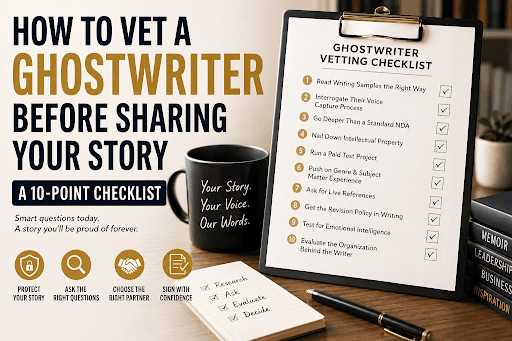
The 10-Point Ghostwriter Vetting Checklist
1. Read Writing Samples the Right Way
2. Interrogate Their Voice Capture Process
| Their Answer | What It Signals |
|---|---|
| "I record everything and do a voice analysis before outlining" | Professional |
| "We do a few calls, and I start writing" | Winging it |
| "I send a questionnaire" | Shallow red flag |
| "I just get a feel for it" | No system, walk away |
3. Go Deeper Than a Standard NDA
- A definition of "confidential information" broad enough to cover everything you'll share
- Explicit prohibition on referencing you as a client, even anonymously
- A survival clause so it holds after project completion
- Coverage of any subcontractors, editors, or research assistants the writer uses
4. Nail Down Intellectual Property — Word for Word
- "At what point does copyright transfer upon signing, payment, or delivery?"
- "Do you retain any rights to use anonymized excerpts in your marketing?"
5. Run a Paid Test Project Before Committing
- Can they actually adopt your voice, or just claim they can?
- How do they handle revision feedback gracefully or defensively?
- How does the collaboration feel in real practice?
6. Push on Genre and Subject Matter Experience
7. Ask for Live References, Not Website Testimonials
- Did the final manuscript sound like them, or like the ghostwriter?
- Were deadlines met without chasing?
- How did the writer respond to critical feedback?
- Would they hire them again without hesitation?
8. Get the Revision Policy in Writing Specifically
9. Test for Emotional Intelligence (Everyone Else Skips This)
10. Evaluate the Organization Behind the Writer
- "What happens to my project if you become unavailable mid-manuscript?"
- "Are any parts of the writing outsourced or AI-assisted?"
Red Flags vs. Green Flags at a Glance
| Situation | Red Flag | Green Flag |
|---|---|---|
| Portfolio | All samples sound identical | Each sample has a distinct voice |
| NDA | Only offered when you ask | Proactively provided upfront |
| Test project | Resists or overcharges | Welcomes it as standard |
| Revision policy | "Unlimited" (undefined) | Clearly defined in the contract |
| AI use | Deflects the question | Transparent about tools |
FAQs
1. How long should the vetting process take?
Allow two to four weeks: at least two calls, sample review, reference checks, and a paid test chapter. Rushing this is how authors end up switching ghostwriters mid-project, which costs far more than patience upfront.
2. Is it normal to pay for a sample chapter?
Yes. Expect $300–$800 for a pro-rated test chapter. Anyone who refuses this before signing you to a full contract should raise immediate concern.
3. What single question best separates a pro from an amateur?
"Tell me about a time a client's voice was extremely different from any style you'd written before. How did you adapt?" Professionals answer with a specific methodology. Amateurs give you vague talk about being "flexible."
4. Should I worry if a ghostwriter won't name past clients?
No, that's actually a good sign. Confidentiality is the cornerstone of professional ghostwriting. Ask for clients who have consented to be references instead.
5. How do I spot a ghostwriting agency scam?
Legitimate agencies have named founders, verifiable history, transparent pricing, and live humans you can speak to before paying. Walk away from anyone demanding large upfront payments before a contract, using high-pressure tactics, or claiming celebrity clients without verifiable proof.
Author Bio:
Isabella Watson is a professional content specialist focused on book publishing and author services. She writes and reviews technical and informative content to help aspiring and seasoned authors navigate the professional publishing process. Her work focuses on quality, trust, and hassle-free creative writing.
GET FREE CONSULTATION
Recent Posts
Why Thousands of Authors Trust Berg Publisher for Professional Publishing Services?
Our Publishing Services Explained | Expert Book Publishing Services
Client Satisfaction Comes First at Berg Publisher Book Publishing Agency
Is hiring a ghostwriter from a ghostwriting agency worth it?
Why professional authors choose ghostwriting services?
Can I Hire a Ghostwriter Online to Write My Life Story?
What are eBook writing services, and how do they help businesses generate leads?
What Berg Publisher Does as a Leading Professional Book Publishing Agency?
A Guide to Understand Rights and Credits Retention in Ghostwriting Services.
Why Book Editing is More Important Than You Think?
How to Choose the Right eBook Writing Service for Your Book or Business?
Common Mistakes Authors Make Without an eBook Writing Service
How Much Do eBook Writing Services Cost?
Professional eBook Writing, Ghostwriting and Editing Services for Authors
Best Book Publishing Agencies for Aspiring Authors 2026
Manuscript getting rejected again and again?: 2026 best book editing service
Explore the top book marketing services: Self-book publishing authors 2026
10 major benefits of hiring fiction ghostwriting services for your novel
How to design a professional book cover that sells in 2026
How to Hire a Fiction Ghostwriter for Your Novel
How to Choose a Book Publishing Agency for International Distribution?
How Book Publishing Agencies Choose Which Manuscripts to Publish?
The Day-to-Day Workflow of a Professional Book Publishing Agency?
How Editors at a Book Publishing Agency Shape Your Manuscript into a Bestseller?
AI vs human ghostwriters: Which is best for writing books in 2026?| ghostwriting services
What Most Authors Don't Know About Book Publishing Agency Submission Processes?
AI Ghostwriting in 2026: How Human Ghostwriters Still Add Value
Ghostwriting Services | Best AI Tools for Writing Books in 2026
Behind the Scenes: How Agencies Decide Marketing Budgets for Books?
How a Book Publishing Agency Evaluates Manuscript Potential (2026 Guide)
Do AI tools beat human writers?| Book publishing services explained
Book Publishing Service Explain, Will AI Replace Authors?
10 Reasons to Hire a Professional eBook Writer in 2026
30+ Questions to Ask an Author About Their Book (With Answer Guides)
How to Write a Book Without Typing
How Book Publishing Services Help Veterans Share Their War Stories?
How Agencies Handle Multiple Authors Efficiently?
How Book Publishing Agency Experts Predict Reader Trends?
Why Book Editing Services and Editors Matter in the AI-Driven Publishing Era?
Pricing Secrets: How a Book Publishing Agency Decides Author Royalties?
How does a Book Marketing Agency Handle Sci-Fi, Fantasy, and Romance Books Differently?
How to Negotiate the Best Deal with a Book Publishing Agency (2026 Guide)
I Published My First Book at 60: Guide to Book Publishing Services for First-Time Authors
The Real Cost of Publishing a Book via Book Publishing Services in 2026?
30+ Questions Every Author Should Ask Before Using Book Publishing Services
Hire an EBook Writer to Build Brand Authority
Why Book Launches Get Delayed (and How to Avoid It)
Is Your Book Ready to Be Published? Check Now
Manuscript to Published Book: A Step-by-Step Guide
Famous CEO Books That Were Written by Ghostwriters
Common Publishing Mistakes Every Author Should Avoid
Legal Requirements for Publishing a Book in the USA
What Successful Self-Published Authors Do Differently
Will Your Book Ever Pay You Back? Here's the Truth
Choosing the Right Genre and Category for Your Book
Hidden Contract Clauses Authors Miss in Book Deals
Best Fiction Writing Services | Berg Publishers
Who Owns a Ghostwritten Book? | Berg Publishers
Book Publishing Services That Don't Hide the Price
Ghostwriter vs. Co-Author: Which One Is Right? | Berg
How CEOs Become Published Authors | Berg Publishers
Amazon Publishing vs. Berg Publishers: Which Wins?
How to Vet a Ghostwriter: A 10-Point Checklist
Vanity Press Warning: 12 Red Flags Before You Sign
eBook Writing Service: How to Choose the Right One
Why Ebooks Fail: 8 Honest Reasons You Can't Ignore
5 Reasons to Hire an Editor Before Self-Publishing a Book
How to Tell If Your Book Is Competing Against an AI Knockoff on Amazon
How to Promote an Ebook After Publishing: Beyond Amazon and Your Website
How to Sell Short Stories on Amazon Kindle: Tips and Tricks for New Authors
8 Podcast Recommendations for Writers and Self-Publishers (2026 Edition)
An Interview with USA Today Bestselling Author Kelly
How Do I Publish a Book for Free on Amazon Kindle Direct Publishing (KDP)? The Complete Step-by-Step Process
AI and Book Publishing in 2026: 4 Changes Every Author Should Know
Which Fonts and Font Sizes Are Best for Your Book's Interior Formatting?
Business Ebook vs Amazon Ebook: Two Completely Different Goals
Cost vs Value: Is a Professional Agency Worth It for Your Book?
15 Creative Book Marketing Ideas for Self-Published Authors (2026 Guide)
2026 Publishing Trends: What Authors, Editors & Publishers Must Know
Internal vs External Conflict: How They Are Used in a Story
Book Royalty Calculator: KDP vs IngramSpark vs Draft2Digital (Exact Math)
Best Publishing Platforms 2026 to 2027: The Ultimate Comparison Guide
AI Book Cover Design: Legal Risks Every US Author Must Know in 2026
How to Hire and Work with a New York Ghostwriting Company
How Much Do Ghostwriters Cost in New York? A Complete NYC Pricing Guide for 2026
The Ultimate Guide on How to Write a Book in 2026
Tips for Authors Writing in Less Popular or Emerging Genres
Top 10 Best Selling Authors of All Time | Book Publishing

We create books that connect with audiences. From the initial outline to publication and marketing, we support our clients throughout the entire process.
SERVICES
- Fiction Ghostwriting
- Non-Fiction Ghostwriting
- Book Editing
- Book Printing
- Book Marketing
- Audiobook Publishing
- Hybrid Publishing
- IngramSpark Publishing
- ISBN and Copyright Registration
- Book Cover Design
- eBook Writing
- Self-Publishing for Tech Founders
- Amazon Publishing
- Self-Publishing vs Traditional Publishing
- Book Publishing Timeline & Process
- Book Publishing Cost USA
- Author Success Stories & Case Studies
- Biography Writing
- Novel Writing