5 Reasons to Hire an Editor Before Self-Publishing a Book
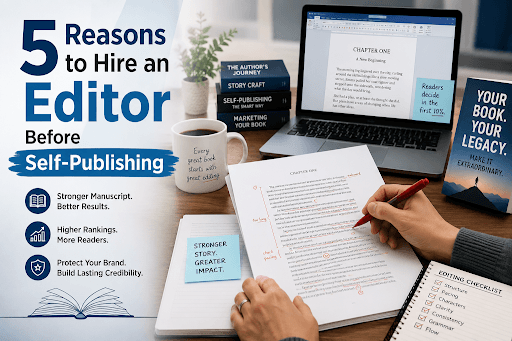
1. Editors Catch Structural Problems You Physically Cannot See in Your Own Manuscript
- Pacing that sags in the middle third (the most common structural complaint in reader reviews)
- POV drift — shifting perspective mid-scene without a clear break
- Plot threads introduced and never resolved
- Character motivation that contradicts earlier established behavior
- Info-dumping in the opening chapters, which kills Amazon's "Look Inside" conversion rate
2. Professional Editing Directly Affects Your Amazon KDP Algorithm Performance
4. Editing Increases Your Options for Traditional Publishing, Rights Deals, and Adaptations
5. Editing Now Costs Significantly Less Than Fixing Mistakes After Launch
- Re-editing and re-uploading after a wave of critical reviews rarely erases the existing reviews — you're paying for the fix and still carrying the damage
- A relaunch under a new cover or edition often requires a new ISBN, new ad creative, and a second marketing spend to rebuild visibility
- Amazon ad spend (AMS) and BookBub promotions convert on the sample pages — poor editing in the first 10% of the book quietly burns ad budget with no return
- Refunds within the KDP return window are a direct financial loss on top of the wasted production cost
Genre-Specific Editing Considerations
What a Professional Book Edit Actually Includes
- A manuscript assessment or editorial letter (for developmental edits) summarizing strengths, priority issues, and specific revision recommendations
- Tracked changes and in-line comments throughout the manuscript, not just a summary memo
- A style sheet documenting spelling variants, character details, timeline, and formatting decisions — critical for series consistency
- A defined number of revision rounds or a follow-up consultation call, specified in the contract before work begins
The Types of Book Editing Services Every Author Should Understand
How Much Do Book Editing Services Cost in 2026?
- Developmental editing: the highest per-word rate, reflecting the depth of manuscript-wide analysis and editorial letter involved
- Line editing: mid-to-high range, scaling with how much prose-level rewriting the manuscript needs
- Copyediting: mid-range, largely driven by manuscript length and consistency issues
- Proofreading: the lowest per-word rate, since it's a single mechanical pass
How to Choose the Right Book Editor for Your Manuscript
- Genre specialization — a thriller editor and a memoir editor are trained to solve different problems; ask for past titles in your genre
- A paid or free sample edit on your actual manuscript, not a generic writing sample
- A written editorial letter (for developmental edits) outlining specific, actionable revision priorities — not just "great job, minor tweaks"
- References or a verifiable portfolio, ideally with titles you can check on Amazon or Goodreads
- A realistic timeline mapped against your KDP launch date, with buffer time for a revision pass after the edit
Conclusion: Editing Isn't an Expense — It's Risk Management for Your Launch
FAQs
1. Do I really need to hire an editor before self-publishing?
Yes, if you want the book to perform. Self-editing alone cannot catch the structural blind spots authors have toward their own work, and unedited manuscripts show up directly in return rates, review sentiment, and Amazon's recommendation algorithm.
2. What's the difference between a book editor and a proofreader?
A book editor addresses structure, prose, and consistency across developmental, line, and copyediting stages. A proofreader performs the final mechanical pass for typos and layout errors after formatting — proofreading alone won't fix structural or craft-level issues.
3. How much do professional book editing services typically cost?
Cost is generally quoted per word and varies by editing stage and manuscript complexity, with developmental editing priced highest and proofreading priced lowest. Requesting a sample edit is the most reliable way to get an accurate quote for your specific manuscript.
4. Can I use AI editing tools instead of hiring a human editor?
AI tools can catch surface-level grammar and consistency issues, but they consistently miss structural problems, tonal nuance, and genre-specific craft judgment. Most professional editors now use AI-assisted tools for mechanical passes while reserving developmental and line-level judgment for human expertise.
5. How long does professional book editing take?
A full developmental-to-proofreading sequence typically takes several weeks to a few months depending on manuscript length and editor availability, so build editing into your KDP launch timeline early rather than treating it as a final-week task.
6. Should I hire an editor before or after beta readers?
Beta readers are most useful after a developmental edit, once the structural issues are already resolved — otherwise their feedback often just rediscovers problems a professional editor would have caught faster and more precisely.
7. Does editing quality really affect Amazon's algorithm, or just reader opinion?
Both. Reader opinion shows up as reviews and star ratings, which are direct ranking and conversion signals, while return rate and read-through rate feed Amazon's recommendation system independently of what reviews say — so editing quality affects visibility even before a reader leaves feedback.
8. What should I look for in a book editor's sample edit?
Look for specific, actionable notes rather than vague praise, evidence they understood your genre's conventions, and a clear rationale behind suggested changes — a strong sample edit should make you feel like the editor understood what you were trying to do, then showed you how to do it more effectively.
Author Bio:
Isabella Watson is a professional content specialist focused on book publishing and author services. She writes and reviews technical and informative content to help aspiring and seasoned authors navigate the professional publishing process. Her work focuses on quality, trust, and hassle-free creative writing.
GET FREE CONSULTATION
Recent Posts
Why Thousands of Authors Trust Berg Publisher for Professional Publishing Services?
Our Publishing Services Explained | Expert Book Publishing Services
Client Satisfaction Comes First at Berg Publisher Book Publishing Agency
Is hiring a ghostwriter from a ghostwriting agency worth it?
Why professional authors choose ghostwriting services?
Can I Hire a Ghostwriter Online to Write My Life Story?
What are eBook writing services, and how do they help businesses generate leads?
What Berg Publisher Does as a Leading Professional Book Publishing Agency?
A Guide to Understand Rights and Credits Retention in Ghostwriting Services.
Why Book Editing is More Important Than You Think?
How to Choose the Right eBook Writing Service for Your Book or Business?
Common Mistakes Authors Make Without an eBook Writing Service
How Much Do eBook Writing Services Cost?
Professional eBook Writing, Ghostwriting and Editing Services for Authors
Best Book Publishing Agencies for Aspiring Authors 2026
Manuscript getting rejected again and again?: 2026 best book editing service
Explore the top book marketing services: Self-book publishing authors 2026
10 major benefits of hiring fiction ghostwriting services for your novel
How to design a professional book cover that sells in 2026
How to Hire a Fiction Ghostwriter for Your Novel
How to Choose a Book Publishing Agency for International Distribution?
How Book Publishing Agencies Choose Which Manuscripts to Publish?
The Day-to-Day Workflow of a Professional Book Publishing Agency?
How Editors at a Book Publishing Agency Shape Your Manuscript into a Bestseller?
AI vs human ghostwriters: Which is best for writing books in 2026?| ghostwriting services
What Most Authors Don't Know About Book Publishing Agency Submission Processes?
AI Ghostwriting in 2026: How Human Ghostwriters Still Add Value
Ghostwriting Services | Best AI Tools for Writing Books in 2026
Behind the Scenes: How Agencies Decide Marketing Budgets for Books?
How a Book Publishing Agency Evaluates Manuscript Potential (2026 Guide)
Do AI tools beat human writers?| Book publishing services explained
Book Publishing Service Explain, Will AI Replace Authors?
10 Reasons to Hire a Professional eBook Writer in 2026
30+ Questions to Ask an Author About Their Book (With Answer Guides)
How to Write a Book Without Typing
How Book Publishing Services Help Veterans Share Their War Stories?
How Agencies Handle Multiple Authors Efficiently?
How Book Publishing Agency Experts Predict Reader Trends?
Why Book Editing Services and Editors Matter in the AI-Driven Publishing Era?
Pricing Secrets: How a Book Publishing Agency Decides Author Royalties?
How does a Book Marketing Agency Handle Sci-Fi, Fantasy, and Romance Books Differently?
How to Negotiate the Best Deal with a Book Publishing Agency (2026 Guide)
I Published My First Book at 60: Guide to Book Publishing Services for First-Time Authors
The Real Cost of Publishing a Book via Book Publishing Services in 2026?
30+ Questions Every Author Should Ask Before Using Book Publishing Services
Hire an EBook Writer to Build Brand Authority
How Much Do Ghostwriters Charge? (Per Word, Per Project, Per Book)
Poetry Publishing: Why It Needs Different Treatment
Why Book Launches Get Delayed (and How to Avoid It)
Is Your Book Ready to Be Published? Check Now
Manuscript to Published Book: A Step-by-Step Guide
Famous CEO Books That Were Written by Ghostwriters
Common Publishing Mistakes Every Author Should Avoid
Legal Requirements for Publishing a Book in the USA
What Successful Self-Published Authors Do Differently
Will Your Book Ever Pay You Back? Here's the Truth
Choosing the Right Genre and Category for Your Book
Hidden Contract Clauses Authors Miss in Book Deals
Best Fiction Writing Services | Berg Publishers
Who Owns a Ghostwritten Book? | Berg Publishers
Book Publishing Services That Don't Hide the Price
Ghostwriter vs. Co-Author: Which One Is Right? | Berg
How CEOs Become Published Authors | Berg Publishers
Amazon Publishing vs. Berg Publishers: Which Wins?
How to Vet a Ghostwriter: A 10-Point Checklist
Vanity Press Warning: 12 Red Flags Before You Sign
eBook Writing Service: How to Choose the Right One
Why Ebooks Fail: 8 Honest Reasons You Can't Ignore
5 Reasons to Hire an Editor Before Self-Publishing a Book
How to Tell If Your Book Is Competing Against an AI Knockoff on Amazon
How to Promote an Ebook After Publishing: Beyond Amazon and Your Website
How to Sell Short Stories on Amazon Kindle: Tips and Tricks for New Authors
8 Podcast Recommendations for Writers and Self-Publishers (2026 Edition)
An Interview with USA Today Bestselling Author Kelly
How Do I Publish a Book for Free on Amazon Kindle Direct Publishing (KDP)? The Complete Step-by-Step Process
AI and Book Publishing in 2026: 4 Changes Every Author Should Know
Which Fonts and Font Sizes Are Best for Your Book's Interior Formatting?
Business Ebook vs Amazon Ebook: Two Completely Different Goals
Cost vs Value: Is a Professional Agency Worth It for Your Book?
15 Creative Book Marketing Ideas for Self-Published Authors (2026 Guide)
2026 Publishing Trends: What Authors, Editors & Publishers Must Know
Internal vs External Conflict: How They Are Used in a Story
Book Royalty Calculator: KDP vs IngramSpark vs Draft2Digital (Exact Math)
Best Publishing Platforms 2026 to 2027: The Ultimate Comparison Guide
AI Book Cover Design: Legal Risks Every US Author Must Know in 2026
How to Hire and Work with a New York Ghostwriting Company
How Much Do Ghostwriters Cost in New York? A Complete NYC Pricing Guide for 2026
The Ultimate Guide on How to Write a Book in 2026
Tips for Authors Writing in Less Popular or Emerging Genres
Top 10 Best Selling Authors of All Time | Book Publishing

We create books that connect with audiences. From the initial outline to publication and marketing, we support our clients throughout the entire process.
SERVICES
- Fiction Ghostwriting
- Non-Fiction Ghostwriting
- Book Editing
- Book Cover Design
- Book Printing
- Book Marketing
- Book Launch Services
- Amazon Ads for Authors
- Amazon Listing Optimization
- Author Website Design
- Audiobook Publishing
- Business Book Publishing
- Children's Book Publishing
- Memoir Publishing
- Hybrid Publishing
- IngramSpark Publishing
- ISBN and Copyright Registration
- eBook Writing
- Self-Publishing for Tech Founders
- Amazon Publishing
- Self-Publishing vs Traditional Publishing
- Book Publishing Timeline & Process
- Book Publishing Cost USA
- Author Success Stories & Case Studies
- Biography Writing
- Novel Writing