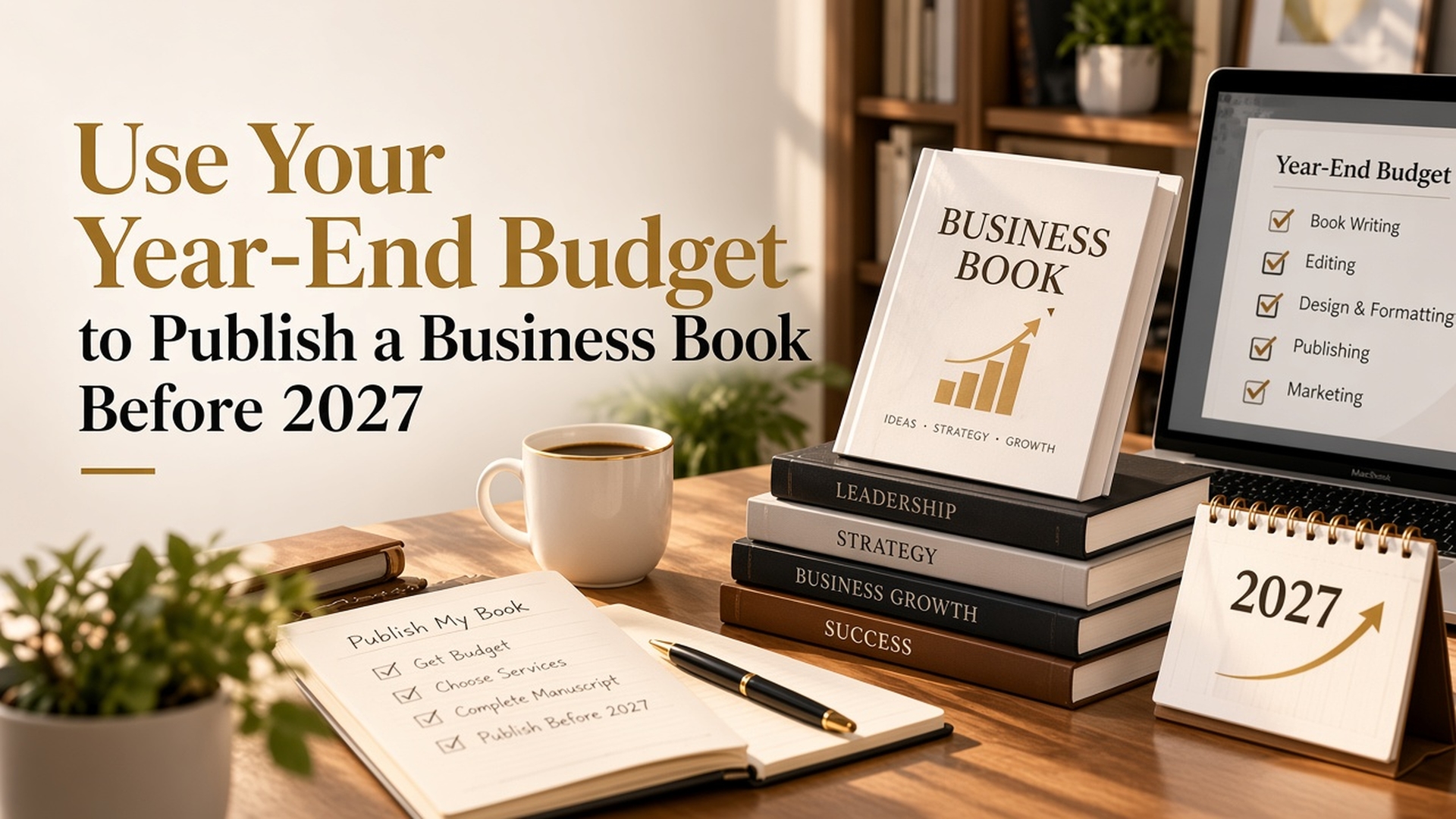
Use Your Year-End Budget to Publish a Business Book Before 2027
Quick Answer
Why Does a Business Book Make Sense for Year-End Budget?
- Use-it-or-lose-it budgets. Many companies and departments lose unspent marketing or professional development budget on December 31. Committing it to a book turns a lost allocation into an asset with a long shelf life.
- January is a strong launch window for business titles. Buyers set annual plans, conference season starts, and executives look for new frameworks. A book funded in December and released in Q1 arrives exactly when your audience is planning.
- Tax timing. If your business uses the cash method, an expense paid in 2026 is generally deducted on your 2026 return. A high-profit year is often the best year to fund long-term marketing. (More on the rules and limits below.)
What Can You Realistically Publish by December 31, 2026?
| Where your manuscript is today | Realistic publish date | What to fund in 2026 | Main risk |
|---|---|---|---|
| Complete and already edited once | Late December 2026 (ebook and paperback) | Proofreading, cover, interior design, ISBNs, distribution setup | Holiday delays; no buffer for a second proof |
| Full rough draft, not yet edited | February to April 2027 | Developmental and copy editing, design, publishing package | Rushing edits to hit an artificial date |
| Outline, notes, or recorded talks only | May to September 2027 | Ghostwriting or book development, strategy, outline | Underestimating your own interview and review time |
Note the gap between funded and published. For lanes two and three, the right goal for 2026 is to commit the budget and start the work, not to publish by a date that forces you to cut corners. A business book that reads as rushed costs more in credibility than it ever saves in taxes.
What slows a December launch down?
- Retailer review. Amazon KDP says new titles can take up to 72 hours to go live, and listings sometimes get held for metadata or content questions. Plan on several days, not hours.
- Printed proofs. If you want to check a physical proof before release, shipping in mid-December can add a week or more.
- Second distribution channel. Wider distribution through IngramSpark for bookstores and libraries has its own setup and approval steps. See our KDP vs IngramSpark comparison for the differences.
- Your own approvals. The most common delay isn't the publisher. It's the executive who needs three days to approve a cover during the busiest week of the year.
Are Business Book Publishing Costs Tax-Deductible?
| Expense | General treatment | What to watch |
|---|---|---|
| Ghostwriting, editing, cover, formatting | Usually deductible as a business expense when paid (cash method) | Payments for work extending well into 2027 may fall under prepaid-expense rules |
| Publishing package, ISBNs, distribution setup | Usually deductible business expense | Keep invoices that describe the specific services |
| Bulk print run of books you will sell | Inventory: generally deducted as copies are sold, not when printed | Small businesses have simplified options; ask your CPA |
| Books given to specific clients | Business gift: deduction generally capped at $25 per recipient per year | A $40 hardcover plus shipping to one client is not fully deductible |
| Books handed out at events or with marketing | Often treated as promotional or advertising cost | Classification depends on facts; document the purpose |
| Launch ads, PR, podcast outreach | Advertising and marketing expense | Deductible in the year the services are performed and paid |
Can you prepay in December for work done in 2027?
What about Section 179 and bonus depreciation?
Five Myths About Year-End Book Spending
- "I have to publish by December 31 to get the deduction." Deductibility generally follows when you pay for and receive services, not when the book appears on Amazon. Publication date and tax year are separate questions.
- "Everything book-related is 100% deductible." Client gift copies, inventory, and long prepayments all have their own rules. The $25 gift limit surprises almost every executive author.
- "A business book needs a traditional publisher to be credible." For most business books, credibility comes from the ideas, the editing, and the design, not the logo on the spine. Traditional publishing also takes 12 to 24 months, which rules it out for any year-end strategy.
- "A cheaper package means a faster book." Speed comes from a finished manuscript and fast decisions. A low-cost package with a shared project manager may move slower during the holidays than a full-service team.
- "Bestseller campaigns are a good use of leftover budget." Buying your way onto a list through bulk purchases can damage credibility if it's discovered, and no honest publisher can guarantee list placement. Spend that money on distribution, a reader resource, and outreach instead.
How Should You Split a Year-End Book Budget?
| Budget tier | Typical range (excluding <strong>ghostwriting</strong>) | Best for |
|---|---|---|
| Lean professional | $3,500 to $7,000 | Finished manuscript; book used mainly for credibility and lead generation |
| Premium | $8,000 to $15,000+ | Competitive category; heavy diagrams; hardcover; launch campaign |
| Full-service with ghostwriting | Quoted per project; well above editing-only costs | Executives with expertise but no time to write |
Within any tier, this allocation framework keeps the money where it creates value:
- Strategy and manuscript (40 to 60%). Positioning, outline, ghostwriting / non-fiction ghostwriting or professional editing. This is where business books succeed or fail.
- Design (10 to 20%). A professional book cover, clean interior layout, and diagrams that make your frameworks easy to remember and share.
- Publishing setup (5 to 10%). ISBN and copyright registration under your company imprint, plus Amazon KDP and IngramSpark distribution.
- Launch and distribution (20 to 30%). Book launch services, Amazon listing optimization, and a bulk print run for events.
Which Publishing Path Fits a Business Book on a Deadline?
| Factor | Self / <strong>independent publishing</strong> | Hybrid publishing | <strong>Traditional publishing</strong> |
|---|---|---|---|
| Time to market | 2–4 weeks from finished manuscript | Months | 12 to 24 months |
| Rights and royalties | You keep 100% | Varies by contract; read carefully | Publisher controls; author earns a royalty share |
| Upfront cost | You pay for services | You pay, often more | Publisher pays; advance possible |
| Imprint and ISBN | Can be your own company imprint | Usually publisher's imprint | Publisher's imprint |
| Works for year-end budget? | Yes | Sometimes | No |
How Do You Choose Book Publishing Services When Time Is Short?
- A fixed written quote with milestones. You should know the deliverable, the date, and the payment attached to each stage. That also gives your accountant clean documentation of what was paid for and when.
- 100% rights and royalties. Confirm in the contract that you own the copyright, the files, and all royalties.
- ISBNs under your imprint. Ask whose name will appear as publisher of record.
- A named project manager. During the holidays, a dedicated contact matters more than any feature list.
- Realistic timeline honesty. If a company promises a ghostwritten, designed, and published book from scratch by December 31, walk away.
- Verifiable work. Look for published books you can check on Amazon and real case studies.
- Clear refund and revision terms. Know what happens if a deadline slips on their side.
What Should You Prepare Before the First Call?
- The current manuscript or source material. A draft, slide decks, recorded talks, or even a list of the client problems you solve most often. Seeing the material, not a description of it, is what lets a publisher tell you which lane you're in.
- One sentence on the reader. For example: "Operations directors at mid-sized manufacturers who are about to automate their first plant." If you can't write this sentence, the book isn't ready to be funded yet, but strategy work is.
- The business outcome. Leads, speaking fees, a sales tool, a recruiting asset, or authority in a new market. Pick one primary goal.
- The real budget and the real deadline. Share the amount that must be committed in 2026 and any hard event dates in 2027, such as a conference or product launch.
- Your approval chain. If legal, compliance, or a co-founder must sign off on content or the cover, name them now. Approval chains, not writing speed, are the most common reason business books miss their dates.
What Does a Nine-Week Sprint to Publication Look Like?
| Week | Dates | Milestone |
|---|---|---|
| 1 | Nov 2 to Nov 6 | Strategy call, fixed quote, contract, title and subtitle locked, ISBNs purchased under your imprint |
| 2 to 3 | Nov 9 to Nov 20 | Final copyedit; cover concepts and first revision run in parallel |
| 4 | Nov 23 to Nov 27 | Thanksgiving week: author reviews edits; cover approved (build in slack here) |
| 5 | Nov 30 to Dec 4 | Proofread; interior layout and diagrams; book description and keywords drafted |
| 6 | Dec 7 to Dec 11 | Final interior approved; ebook and print files produced; metadata finalized |
| 7 | Dec 14 to Dec 18 | Upload to KDP (and IngramSpark if included); digital proof checked; target go-live |
| 8 to 9 | Dec 21 to Dec 31 | Buffer for retailer review; author page; reader resource and launch emails scheduled for January |
What Should a Business Book Do After It Is Published?
- Lead generation. A downloadable resource in the book (templates, assessments, a scorecard) moves readers from the page to your email list.
- Sales enablement. Your team sends a copy before or after a discovery call. Sales cycles shorten when buyers have already read your methodology.
- Speaking and media. Event organizers and podcast hosts book authors. A book is often the difference between pitching and being invited.
- Search and AI visibility. A published book with an ISBN, a Google Books record, an Amazon author page, and consistent author information across your website creates clear entity signals about who you are and what you're an expert in. AI assistants and search engines rely on those signals when deciding which experts to name in their answers. Support it with an author website that uses Book and Person structured data.
Three Year-End Scenarios: Which One Is You?
The consultant with a finished manuscript
The SaaS founder with a rough draft
The agency owner with only an idea
Common Mistakes When Using Year-End Budget for a Book
- Choosing the publisher before defining the reader. A book written for "business owners" serves nobody. Define one reader and one outcome first.
- Paying 100% upfront for a 12-month project without checking how your CPA will treat the prepayment.
- Printing 2,000 copies in December because it feels like a big deductible purchase. Printed books you plan to sell are generally inventory, not an immediate expense.
- Skipping the professional cover to save money. For business books, the cover is the first credibility check on Amazon and on a conference table.
- Launching during the holidays. Publish in December if you can; launch in January.
- No reader resource. A book without a next step for the reader is a business card nobody can call back.
Key Takeaways
- You can turn unspent 2026 budget into a business book, but only a finished manuscript can realistically be published before 2027.
- For most other authors, the smart goal is to fund and start the book now and launch in Q1 or Q2 2027.
- Writing, editing, design, and marketing costs are generally ordinary business expenses, but inventory, client gifts, and long prepayments have their own rules. Confirm with your CPA.
- Section 179 is for equipment and similar property. A book project is not a Section 179 purchase.
- Independent publishing under your own imprint gives business authors speed, full rights, and control over bulk copies.
- Choose book publishing services on milestones, rights, and honesty about timelines, not on promises to beat December 31.
Frequently Asked Questions
1. Can I publish a business book in two months?
Yes, if the manuscript is complete and has been edited at least once. Final editing, cover, interior design, ISBNs, and distribution can be finished in 2–4 weeks when stages run in parallel. A book that still needs writing or developmental editing should still be funded now, with the publishing steps kept to the same 2–4 week window once the manuscript is ready.
2. Is ghostwriting tax-deductible for a business?
Ghostwriting for a book used to market your business is generally treated as an ordinary business expense. Timing depends on your accounting method and when the work is performed. If you prepay in December for work done mostly in 2027, ask your CPA whether the 12-month rule applies.
3. Do I need to publish the book in 2026 to deduct 2026 costs?
Generally, no. Deductions follow when expenses are paid and services are performed, not the publication date. Individual freelance authors are also protected from capitalization rules under Section 263A(h). Confirm the specifics with your tax advisor.
4. How much does it cost to publish a business book in the USA?
A professionally self-published full-length book typically costs $2,000 to $15,000, with most first-time authors spending $3,500 to $7,000. Ghostwriting is quoted separately and costs significantly more. See our book publishing cost guide for a line-by-line breakdown.
5. Should I use a traditional publisher or independent publishing for a business book?
For a year-end strategy, independent publishing is the only realistic option, because traditional publishing usually takes 12 to 24 months. Independent publishing also lets you keep full rights, reuse your frameworks, and buy author copies at print cost.
6. What happens if my book isn't ready by December 31?
Nothing goes wrong as long as the plan is honest. If the 2026 budget paid for real work in 2026, the book can launch in 2027 on a schedule that protects quality. A January to March launch is often better for business titles anyway.
7. Should I publish an audiobook too?
Many business readers listen during commutes and travel, so an audiobook can widen your reach. On a year-end timeline, publish the ebook and paperback first and produce the audiobook in Q1 from the final approved text. Narration recorded from an unfinished manuscript usually has to be redone. Learn more about audiobook publishing.
8. Can I publish my book under my company name?
Yes. Buy ISBNs under your company as the publisher, register copyright, and list the company imprint on Amazon and IngramSpark. It's the standard approach for executives and consultancies.
Ready to Put This Year's Budget to Work?
References
- IRS Publication 538: Accounting Periods and Methods
- 26 U.S. Code § 263A, including subsection (h) for freelance authors
- 26 U.S. Code § 274(b): business gift deduction limit
- IRS Revenue Procedure 2025-32: 2026 inflation adjustments ($32 million gross receipts test; $2.56 million Section 179 limit)
- Berg Publisher internal data: publishing timeline and process and book publishing cost (USA)
Author Bio:
Isabella Watson is a professional content specialist focused on book publishing and author services. She writes and reviews technical and informative content to help aspiring and seasoned authors navigate the professional publishing process. Her work focuses on quality, trust, and hassle-free creative writing.
GET FREE CONSULTATION
Recent Posts
Ebook Royalties Explained: How Much Do Authors Actually Earn Per Sale?
IngramSpark Wholesale Discount & Returns Explained
Use Your Year-End Budget to Publish a Business Book Before 2027
Do You Really Own Your Book? The Truth About 100% Royalties, ISBN Ownership & Publishing Rights Before You Sign With a Book Publishing Company (2026–2027)
Why Thousands of Authors Trust Berg Publisher for Professional Publishing Services?
Our Publishing Services Explained | Expert Book Publishing Services
Client Satisfaction Comes First at Berg Publisher Book Publishing Agency
Is hiring a ghostwriter from a ghostwriting agency worth it?
Why professional authors choose ghostwriting services?
Can I Hire a Ghostwriter Online to Write My Life Story?
What are eBook writing services, and how do they help businesses generate leads?
What Berg Publisher Does as a Leading Professional Book Publishing Agency?
A Guide to Understand Rights and Credits Retention in Ghostwriting Services.
Why Book Editing is More Important Than You Think?
How to Choose the Right eBook Writing Service for Your Book or Business?
Common Mistakes Authors Make Without an eBook Writing Service
How Much Do eBook Writing Services Cost?
Professional eBook Writing, Ghostwriting and Editing Services for Authors
Best Book Publishing Agencies for Aspiring Authors 2026
Manuscript getting rejected again and again?: 2026 best book editing service
Explore the top book marketing services: Self-book publishing authors 2026
10 major benefits of hiring fiction ghostwriting services for your novel
How to design a professional book cover that sells in 2026
How to Hire a Fiction Ghostwriter for Your Novel
How to Choose a Book Publishing Agency for International Distribution?
How Book Publishing Agencies Choose Which Manuscripts to Publish?
The Day-to-Day Workflow of a Professional Book Publishing Agency?
How Editors at a Book Publishing Agency Shape Your Manuscript into a Bestseller?
AI vs human ghostwriters: Which is best for writing books in 2026?| ghostwriting services
What Most Authors Don't Know About Book Publishing Agency Submission Processes?
AI Ghostwriting in 2026: How Human Ghostwriters Still Add Value
Ghostwriting Services | Best AI Tools for Writing Books in 2026
Behind the Scenes: How Agencies Decide Marketing Budgets for Books?
How a Book Publishing Agency Evaluates Manuscript Potential (2026 Guide)
Do AI tools beat human writers?| Book publishing services explained
Book Publishing Service Explain, Will AI Replace Authors?
10 Reasons to Hire a Professional eBook Writer in 2026
30+ Questions to Ask an Author About Their Book (With Answer Guides)
How to Write a Book Without Typing
How Book Publishing Services Help Veterans Share Their War Stories?
How Agencies Handle Multiple Authors Efficiently?
How Book Publishing Agency Experts Predict Reader Trends?
Why Book Editing Services and Editors Matter in the AI-Driven Publishing Era?
Pricing Secrets: How a Book Publishing Agency Decides Author Royalties?
How does a Book Marketing Agency Handle Sci-Fi, Fantasy, and Romance Books Differently?
How to Negotiate the Best Deal with a Book Publishing Agency (2026 Guide)
I Published My First Book at 60: Guide to Book Publishing Services for First-Time Authors
The Real Cost of Publishing a Book via Book Publishing Services in 2026?
30+ Questions Every Author Should Ask Before Using Book Publishing Services
Hire an EBook Writer to Build Brand Authority
IngramSpark vs KDP Print: Which to Use (and How to Use Both)
What Should a Publishing Services Contract Include? (Rights, Royalties, Exit Terms)
Is Paying for Book Publishing Worth It? An Honest ROI Breakdown
Freelance Editor vs Publishing Agency: Which Is Right for Your Book?
KDP Rejected My Book: Common Reasons and How to Fix Them
How Much Do Ghostwriters Charge? (Per Word, Per Project, Per Book)
Poetry Publishing: Why It Needs Different Treatment
Why Book Launches Get Delayed (and How to Avoid It)
Is Your Book Ready to Be Published? Check Now
Manuscript to Published Book: A Step-by-Step Guide
Famous CEO Books That Were Written by Ghostwriters
Common Publishing Mistakes Every Author Should Avoid
Legal Requirements for Publishing a Book in the USA
What Successful Self-Published Authors Do Differently
Will Your Book Ever Pay You Back? Here's the Truth
Choosing the Right Genre and Category for Your Book
Hidden Contract Clauses Authors Miss in Book Deals
Best Fiction Writing Services | Berg Publishers
Who Owns a Ghostwritten Book? | Berg Publishers
Book Publishing Services That Don't Hide the Price
Ghostwriter vs. Co-Author: Which One Is Right? | Berg
How CEOs Become Published Authors | Berg Publishers
Amazon Publishing vs. Berg Publishers: Which Wins?
How to Vet a Ghostwriter: A 10-Point Checklist
Vanity Press Warning: 12 Red Flags Before You Sign
eBook Writing Service: How to Choose the Right One
Why Ebooks Fail: 8 Honest Reasons You Can't Ignore
5 Reasons to Hire an Editor Before Self-Publishing a Book
How to Tell If Your Book Is Competing Against an AI Knockoff on Amazon
How to Promote an Ebook After Publishing: Beyond Amazon and Your Website
How to Sell Short Stories on Amazon Kindle: Tips and Tricks for New Authors
8 Podcast Recommendations for Writers and Self-Publishers (2026 Edition)
An Interview with USA Today Bestselling Author Kelly
How Do I Publish a Book for Free on Amazon Kindle Direct Publishing (KDP)? The Complete Step-by-Step Process
AI and Book Publishing in 2026: 4 Changes Every Author Should Know
Which Fonts and Font Sizes Are Best for Your Book's Interior Formatting?
Business Ebook vs Amazon Ebook: Two Completely Different Goals
Cost vs Value: Is a Professional Agency Worth It for Your Book?
15 Creative Book Marketing Ideas for Self-Published Authors (2026 Guide)
2026 Publishing Trends: What Authors, Editors & Publishers Must Know
Internal vs External Conflict: How They Are Used in a Story
Book Royalty Calculator: KDP vs IngramSpark vs Draft2Digital (Exact Math)
Best Publishing Platforms 2026 to 2027: The Ultimate Comparison Guide
AI Book Cover Design: Legal Risks Every US Author Must Know in 2026
How to Hire and Work with a New York Ghostwriting Company
How Much Do Ghostwriters Cost in New York? A Complete NYC Pricing Guide for 2026
The Ultimate Guide on How to Write a Book in 2026
Tips for Authors Writing in Less Popular or Emerging Genres
Top 10 Best Selling Authors of All Time | Book Publishing

We create books that connect with audiences. From the initial outline to publication and marketing, we support our clients throughout the entire process.
SERVICES
- Fiction Ghostwriting
- Non-Fiction Ghostwriting
- Book Editing
- Book Cover Design
- Book Printing
- Book Marketing
- Book Launch Services
- Amazon Ads for Authors
- Amazon Listing Optimization
- Author Website Design
- Audiobook Publishing
- Business Book Publishing
- Children's Book Publishing
- Memoir Publishing
- Hybrid Publishing
- IngramSpark Publishing
- ISBN and Copyright Registration
- eBook Writing
- Self-Publishing for Tech Founders
- Amazon Publishing
- Self-Publishing vs Traditional Publishing
- Book Publishing Timeline & Process
- Book Publishing Cost USA
- Author Success Stories & Case Studies
- Biography Writing
- Novel Writing