IngramSpark vs KDP Print: Which to Use (and How to Use Both)
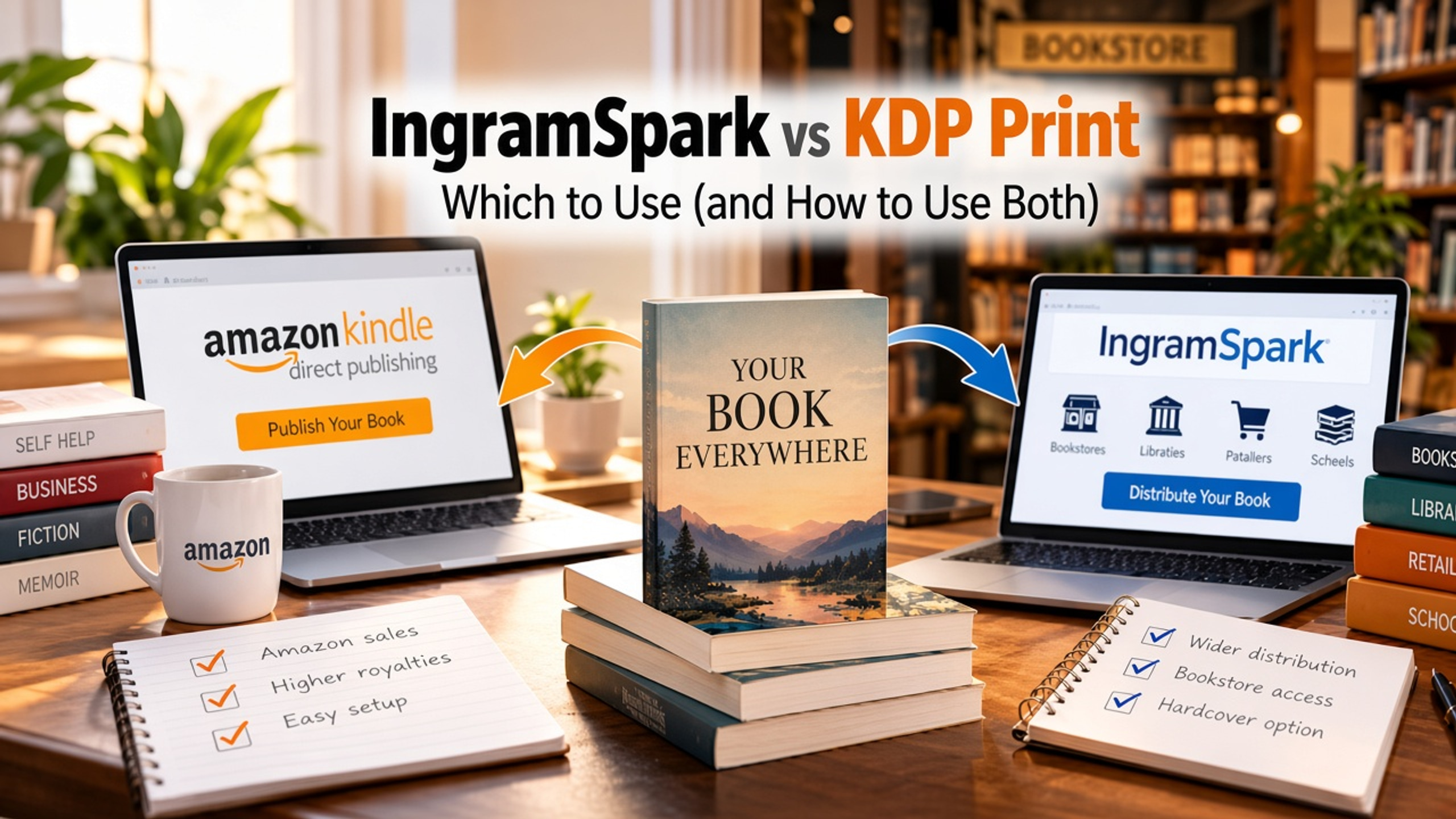
What's the Difference Between IngramSpark and KDP Print?
- KDP Print is Amazon's own service. It's the simplest way to sell paperbacks and hardcovers on Amazon.
- IngramSpark is run by Ingram, the largest book distributor in the world. It's how bookstores, libraries, and other retailers order books. Ingram's reach is the reason most indie books end up on bookstore shelves at all.
Side-by-side comparison (2026)
| Feature | KDP Print | IngramSpark |
|---|---|---|
| Best for | Selling on Amazon | Bookstores, libraries, other retailers |
| Setup fee | Free | Free |
| Changing files later | Free | Free (since Feb 1, 2026) |
| Distribution fee | None | 1.875% of list price per sale |
| Reach | Amazon marketplaces | 45,000+ retailers, libraries, and schools |
| Free ISBN offered? | Yes (Amazon-only) | No, you supply your own |
| Bookstore returns | No option | You choose returnable or not |
| Hardcover with dust jacket | No | Yes |
| Payment timing | About 60 days after month end | About 90 days after month end |
Which One Should You Use?
- Most of your readers buy on Amazon
- You're publishing a family history or memoir mainly for friends and relatives
- You don't plan to approach bookstores or libraries
- You only want bookstore and library distribution
- You need a hardcover with a dust jacket for a gift or legacy book
- You want the best royalties on Amazon and access to bookstores and libraries
- You plan to do local signings, author events, or library talks
- You want your book to look and feel like a professionally published title
Why Does KDP's Expanded Distribution Cause a Conflict?
How Do You Set Up Both Without a Conflict? (Step by Step)
- KDP's free ISBN can only be used on Amazon, and it lists Amazon as the publisher
- You need one ISBN per format: paperback, hardcover, and ebook each get their own
- Buying a block of 10 is usually better value than buying one at a time
You'll use the same interior PDF on both platforms. But be careful with the cover:
- Each platform has its own cover template
- Spine width can differ slightly between the two, because page thickness varies
- Download the template from each platform using your exact page count and trim size
| Your situation | Upload first | Why |
|---|---|---|
| Doing a pre-order | IngramSpark first | Let bookstores see and order your book early |
| No pre-order | Either one (KDP is often first) | Just keep Expanded Distribution unticked |
Step 4: Set up KDP Print correctly
- Enter your own Bowker ISBN (not the free one)
- Upload your interior and KDP cover
- On the Paperback Rights & Pricing page, make sure Expanded Distribution is NOT ticked
- Set your list price at $9.99 or higher to get the 60% royalty rate. Below that, KDP pays 50%
Step 5: Set up IngramSpark correctly
- Enter the exact same ISBN
- Upload the same interior and your IngramSpark cover
- Turn on global distribution
- Set your wholesale discount (more on this below)
- Decide whether to allow returns (bookstores strongly prefer returnable books)
Step 6: Match the details on both
- Title and subtitle
- Author name (spelled exactly the same)
- Trim size and page count
- List price
Your quick-reference settings:
| Setting | KDP Print | IngramSpark |
|---|---|---|
| ISBN | Your Bowker ISBN | Same Bowker ISBN |
| Expanded Distribution | OFF | Not applicable |
| Distribution | Amazon | Global (all retailers) |
| Wholesale discount | Not applicable | 40–55% (55% for bookstore focus) |
| Returns | Not applicable | Returnable if targeting bookstores |
| List price | Same on both | Same on both |
Step 7: Check your listings after launch
What If You Already Turned On Expanded Distribution?
- Log in to KDP and go to your paperback's Rights & Pricing page
- Untick Expanded Distribution and save
- Wait. It can take several weeks for the change to clear Ingram's system
- Contact IngramSpark support and ask to transfer the title to your account. ALLI's Watchdog has advised that a locked ISBN may need a "title transfer addendum" to free it for your use
Option 2: Use a new ISBN (faster, but trade-offs)
- Assign a new ISBN for the IngramSpark version
- Faster, but you may end up with two listings for the same book
- Reviews and sales history may be split between them
Option 3: Start fresh if you used KDP's free ISBN
How Much Will You Actually Earn on Each Platform?
| Sale channel | How it's calculated | You earn (approx.) |
|---|---|---|
| KDP, sold on Amazon | 60% of $16.99 minus $4.60 printing | ~$5.59 |
| KDP Expanded Distribution | 40% of $16.99 minus $4.60 printing | ~$2.20 |
| IngramSpark, 50% wholesale discount | $16.99 minus $5.71 printing, minus 1.875% fee, minus 50% discount | ~$4.17 |
| IngramSpark, 55% discount | Same formula with bookstore-level discount | ~$1.62 |
What this tells you
- Amazon sales pay better. That's why KDP should handle Amazon.
- IngramSpark isn't about higher royalties per copy. It's about access: bookstores, libraries, returns, and hardcovers with dust jackets.
What Are the Most Common Mistakes to Avoid?
- Using KDP's free ISBN when you plan to use IngramSpark later
- Ticking Expanded Distribution "just in case"
- Using one cover file on both platforms (spine widths can differ)
- Different prices or titles on each platform
- Turning on returns without understanding that if a bookstore returns copies, the cost comes back to you
- Forgetting the hardcover. KDP hardcovers can't use Expanded Distribution, so IngramSpark is often the better home for a jacketed edition
Want This Set Up for You, the Right Way?
- Your own ISBN, registered in your name (you stay the publisher of record)
- Print-ready files for both platforms, including separate cover templates
- Correct settings for distribution, discounts, returns, and pricing
- Pre-order setup if you want bookstores to order early
- Expanded Distribution rescue: if your book is already locked, we'll help untangle it
- Plain-English guidance at every step, with a real person you can call, not just a help-desk ticket
Get a free publishing review
The Bottom Line
- KDP Print is best for selling on Amazon.
- IngramSpark is best for bookstores, libraries, and premium hardcovers.
- Own your ISBN
- Keep Expanded Distribution turned off on KDP
- Use the same ISBN and matching details on both platforms
FAQs
1. Can I use IngramSpark and KDP Print for the same book?
Yes. Many authors do. You need your own ISBN (not KDP's free one), and you must leave Expanded Distribution turned off on KDP. Then you can use the same ISBN on both KDP Print and IngramSpark.
2. Why does IngramSpark say my ISBN is already in use?
Usually Expanded Distribution was turned on in KDP. Amazon used Ingram to distribute those books, so your ISBN was already registered in Ingram's system. Turn off Expanded Distribution, wait for it to clear, and contact IngramSpark about transferring the title.
3. Should I turn on KDP Expanded Distribution?
If you're also using IngramSpark, no. If you're only using KDP, it can add some extra reach, but royalties drop to 40% minus printing, and bookstores rarely order books that aren't returnable.
4. Does IngramSpark still charge a setup or revision fee?
Not in 2026. The setup fee is free, and revision fees were removed on February 1, 2026. IngramSpark now charges a 1.875% distribution fee on each sale instead.
5. Will my book get into bookstores if I use IngramSpark?
IngramSpark makes your book available to bookstores and libraries, but stores still decide whether to stock it. A 55% wholesale discount, returnable status, a professional cover, and local outreach all improve your chances.
Author Bio:
Isabella Watson is a professional content specialist focused on book publishing and author services. She writes and reviews technical and informative content to help aspiring and seasoned authors navigate the professional publishing process. Her work focuses on quality, trust, and hassle-free creative writing.
GET FREE CONSULTATION
Recent Posts
Ebook Royalties Explained: How Much Do Authors Actually Earn Per Sale?
IngramSpark Wholesale Discount & Returns Explained
Use Your Year-End Budget to Publish a Business Book Before 2027
Do You Really Own Your Book? The Truth About 100% Royalties, ISBN Ownership & Publishing Rights Before You Sign With a Book Publishing Company (2026–2027)
Why Thousands of Authors Trust Berg Publisher for Professional Publishing Services?
Our Publishing Services Explained | Expert Book Publishing Services
Client Satisfaction Comes First at Berg Publisher Book Publishing Agency
Is hiring a ghostwriter from a ghostwriting agency worth it?
Why professional authors choose ghostwriting services?
Can I Hire a Ghostwriter Online to Write My Life Story?
What are eBook writing services, and how do they help businesses generate leads?
What Berg Publisher Does as a Leading Professional Book Publishing Agency?
A Guide to Understand Rights and Credits Retention in Ghostwriting Services.
Why Book Editing is More Important Than You Think?
How to Choose the Right eBook Writing Service for Your Book or Business?
Common Mistakes Authors Make Without an eBook Writing Service
How Much Do eBook Writing Services Cost?
Professional eBook Writing, Ghostwriting and Editing Services for Authors
Best Book Publishing Agencies for Aspiring Authors 2026
Manuscript getting rejected again and again?: 2026 best book editing service
Explore the top book marketing services: Self-book publishing authors 2026
10 major benefits of hiring fiction ghostwriting services for your novel
How to design a professional book cover that sells in 2026
How to Hire a Fiction Ghostwriter for Your Novel
How to Choose a Book Publishing Agency for International Distribution?
How Book Publishing Agencies Choose Which Manuscripts to Publish?
The Day-to-Day Workflow of a Professional Book Publishing Agency?
How Editors at a Book Publishing Agency Shape Your Manuscript into a Bestseller?
AI vs human ghostwriters: Which is best for writing books in 2026?| ghostwriting services
What Most Authors Don't Know About Book Publishing Agency Submission Processes?
AI Ghostwriting in 2026: How Human Ghostwriters Still Add Value
Ghostwriting Services | Best AI Tools for Writing Books in 2026
Behind the Scenes: How Agencies Decide Marketing Budgets for Books?
How a Book Publishing Agency Evaluates Manuscript Potential (2026 Guide)
Do AI tools beat human writers?| Book publishing services explained
Book Publishing Service Explain, Will AI Replace Authors?
10 Reasons to Hire a Professional eBook Writer in 2026
30+ Questions to Ask an Author About Their Book (With Answer Guides)
How to Write a Book Without Typing
How Book Publishing Services Help Veterans Share Their War Stories?
How Agencies Handle Multiple Authors Efficiently?
How Book Publishing Agency Experts Predict Reader Trends?
Why Book Editing Services and Editors Matter in the AI-Driven Publishing Era?
Pricing Secrets: How a Book Publishing Agency Decides Author Royalties?
How does a Book Marketing Agency Handle Sci-Fi, Fantasy, and Romance Books Differently?
How to Negotiate the Best Deal with a Book Publishing Agency (2026 Guide)
I Published My First Book at 60: Guide to Book Publishing Services for First-Time Authors
The Real Cost of Publishing a Book via Book Publishing Services in 2026?
30+ Questions Every Author Should Ask Before Using Book Publishing Services
Hire an EBook Writer to Build Brand Authority
IngramSpark vs KDP Print: Which to Use (and How to Use Both)
What Should a Publishing Services Contract Include? (Rights, Royalties, Exit Terms)
Is Paying for Book Publishing Worth It? An Honest ROI Breakdown
Freelance Editor vs Publishing Agency: Which Is Right for Your Book?
KDP Rejected My Book: Common Reasons and How to Fix Them
How Much Do Ghostwriters Charge? (Per Word, Per Project, Per Book)
Poetry Publishing: Why It Needs Different Treatment
Why Book Launches Get Delayed (and How to Avoid It)
Is Your Book Ready to Be Published? Check Now
Manuscript to Published Book: A Step-by-Step Guide
Famous CEO Books That Were Written by Ghostwriters
Common Publishing Mistakes Every Author Should Avoid
Legal Requirements for Publishing a Book in the USA
What Successful Self-Published Authors Do Differently
Will Your Book Ever Pay You Back? Here's the Truth
Choosing the Right Genre and Category for Your Book
Hidden Contract Clauses Authors Miss in Book Deals
Best Fiction Writing Services | Berg Publishers
Who Owns a Ghostwritten Book? | Berg Publishers
Book Publishing Services That Don't Hide the Price
Ghostwriter vs. Co-Author: Which One Is Right? | Berg
How CEOs Become Published Authors | Berg Publishers
Amazon Publishing vs. Berg Publishers: Which Wins?
How to Vet a Ghostwriter: A 10-Point Checklist
Vanity Press Warning: 12 Red Flags Before You Sign
eBook Writing Service: How to Choose the Right One
Why Ebooks Fail: 8 Honest Reasons You Can't Ignore
5 Reasons to Hire an Editor Before Self-Publishing a Book
How to Tell If Your Book Is Competing Against an AI Knockoff on Amazon
How to Promote an Ebook After Publishing: Beyond Amazon and Your Website
How to Sell Short Stories on Amazon Kindle: Tips and Tricks for New Authors
8 Podcast Recommendations for Writers and Self-Publishers (2026 Edition)
An Interview with USA Today Bestselling Author Kelly
How Do I Publish a Book for Free on Amazon Kindle Direct Publishing (KDP)? The Complete Step-by-Step Process
AI and Book Publishing in 2026: 4 Changes Every Author Should Know
Which Fonts and Font Sizes Are Best for Your Book's Interior Formatting?
Business Ebook vs Amazon Ebook: Two Completely Different Goals
Cost vs Value: Is a Professional Agency Worth It for Your Book?
15 Creative Book Marketing Ideas for Self-Published Authors (2026 Guide)
2026 Publishing Trends: What Authors, Editors & Publishers Must Know
Internal vs External Conflict: How They Are Used in a Story
Book Royalty Calculator: KDP vs IngramSpark vs Draft2Digital (Exact Math)
Best Publishing Platforms 2026 to 2027: The Ultimate Comparison Guide
AI Book Cover Design: Legal Risks Every US Author Must Know in 2026
How to Hire and Work with a New York Ghostwriting Company
How Much Do Ghostwriters Cost in New York? A Complete NYC Pricing Guide for 2026
The Ultimate Guide on How to Write a Book in 2026
Tips for Authors Writing in Less Popular or Emerging Genres
Top 10 Best Selling Authors of All Time | Book Publishing

We create books that connect with audiences. From the initial outline to publication and marketing, we support our clients throughout the entire process.
SERVICES
- Fiction Ghostwriting
- Non-Fiction Ghostwriting
- Book Editing
- Book Cover Design
- Book Printing
- Book Marketing
- Book Launch Services
- Amazon Ads for Authors
- Amazon Listing Optimization
- Author Website Design
- Audiobook Publishing
- Business Book Publishing
- Children's Book Publishing
- Memoir Publishing
- Hybrid Publishing
- IngramSpark Publishing
- ISBN and Copyright Registration
- eBook Writing
- Self-Publishing for Tech Founders
- Amazon Publishing
- Self-Publishing vs Traditional Publishing
- Book Publishing Timeline & Process
- Book Publishing Cost USA
- Author Success Stories & Case Studies
- Biography Writing
- Novel Writing